29dB attenuation? Why is 5dB more likely? You really need to know why...
Most organisations have no idea of the attenuation being achieved by hearing protection as used in the workplace, despite PPE being the only basis for most hearing conservation programmes. That is not an acceptable situation.
Our free real-world PPE attenuation calculator provides you with realistic estimates of the protection achieved in your working environment for conventional PPE. In most circumstances this will be 5dB - 10dB, not 20dB - 30dB. It also allows you to trial "what if" changes to improve performance dramatically and to aid evaluation of your Return on Investment (RoI) for your workplace hearing protection regime.
Real world PPE performance
Why is it so poor?
This information has been available for decades. It is not new, and yet most hearing conservation programmes are still based on the false assumption that PPE is orders of magnitude more effective than the reality. Welcome to the reality...
Webinar: a guide to the latest best practice in noise risk reduction.
Noise >90dB(A)? Very hard to guarantee adequate protection. Your options are?
If you need 10dB or more attenuation from hearing protectors, it is extremely difficult to guarantee adequate protection with conventional PPE. The following are your options to protect at noise levels above c 90dB(A):

- Noise control: cutting noise from perhaps 92dB(A) to 89dB(A) halves (-3dB=50%) the PPE wearers' risk and makes adequate PPE performance more tenable. Similarly, using modern low-cost engineering noise control to cut noise levels from 98dB(A) to 92dB(A) would reduce risk by 75%.
- PPE calculator: "what if" the values (wear rate in particular) to improve performance. Almost certainly you will need to audit and improve wear rates.
- Intelligent PPE: assess using the latest electronic, internet enabled PPE for automatic wear rate data and noise dose recording.
Supplier data v real-world PPE attenuation
There is virtually no relationship between these 2 values. The HSE Control of Noise at Work guidance recommends derating the supplier assumed protection by 4dB to allow for "reality". This is totally inadequate. In fact, the HSE has recently published a PPE performance video illustrating this fact (our version here has noise attenuation values added for clarification: view the original version).
Supplier hearing protection data is almost irrelevant unless you can control all the workplace factors that impact the attenuation achieved by the user.
How does the PPE performance calculator work?
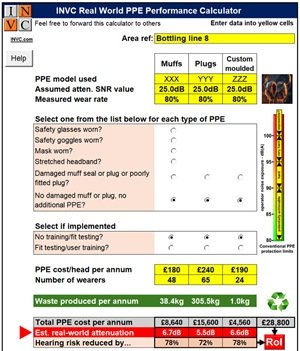
The calculator takes the supplied assumed PPE protection value and then derates the attenuation based on research data and the answers to simple questions about the list of factors that affect performance.
The questions include:
- wear rate: measured and regularly audited and documented, not the assumed rate
- other PPE (for earmuffs): safety glasses, goggles, mask, hat...
- condition (plugs and muffs): stretched headband, damaged seals or plugs
- how well fitted: fit-testing and training
The results for earmuffs, earplugs and custom moulded plugs are then used to estimate the field attenuation for your specific circumstances.
Return on Investment and waste
It also adds a calculator for PPE costs and waste produced. Combined with the estimated real-world attenuation, it provides invaluable data to aid calculation of the RoI and to test the effects of changes in these factors. Guide to RoI evaluation >>.
Field protection data and resources

HSE inspection and report data on PPE makes depressing reading
- >75% of employees exposed to dangerous noise levels lack key knowledge on how to use their PPE
- 63% of users had had no guidance on their use
- 40% of users got no protection at all
- 60% had inadequate protection
- 14% did not wear hearing protectors
See summary of HSE inspection findings on PPE use, HSE post on PPE use and HSE Research Report RR720.

Historical PPE field performance data
These graphs show a summary of the report on the field performance of typical earplugs and earmuffs compared with the manufacturers' data. Note the date, 1996...
- earplugs: not 15dB - 28dB, but 2dB - 12dB attenuation as fitted
- earmuffs: not 22dB - 25dB, but 10dB - 16dB attenuation as fitted
Then add the effect of wear rates less than 100% (e.g. a wear rate of perhaps 90% limits the maximum attenuation of any protector to around 9dB) and other PPE.
This information has been available for decades and yet almost no-one bases their risk assessment PPE performance on realistic figures. So a host of hearing protection users are suffering unnecessary hearing damage.
It's long past time to change these false and damaging assumptions.
Our real-world PPE attenuation calculator tool highlights the issues - and the potential for improvement.
