
Posted on: Jan. 30, 2026
How to improve noise report quality. Perhaps a template?
Expressing 40 years of frustration since founding INVC... Peter Wilson
I see a lot of reports (we developed and run the IOSH noise competency courses). Most are placebo check-box reports that tell you what you already know, that you still have a noise problem. What they don’t tell you is how best to reduce hearing damage risk.
You need to write or acquire a template report for all future risk assessments (consultant or in-house) to ensure quality and to enable you to track progress in risk reduction (very difficult if all reports have different formats and content).
I’ve been writing noise risk assessment reports for decades with the added benefit of seeing hosts of other reports. Given the current dire state of play documented by the HSE, I’ve decided to use that experience to develop what I modestly consider to be the ultimate high-end benchmark report to encourage better quality. It will shortly be released into the wild as an open source resource. Free to use, free to copy and paste to create bespoke or massively cut-down (for simple sites) versions.

We can even generate bespoke versions for you if required, such as the version I recently provided for a major insurance company.
Typical noise report content. Useful much?
After spending £thousands on a report, you're presented with what I call, a “write only report” where, understandably, very little of it has ever been read. Summarising the typical content:

No useful, best practice Action Plan to reduce risk, despite it being the sole reason for the report.
HSE report quality survey results (spoiler alert, D-)
That’s not just my opinion. 2025 HSE noise report quality survey: 60% of noise reports are unsatisfactory; 14% poor; 6% very poor. Their 2002 survey: 63% of reports were deemed “inadequate”. So, nothing has changed in over 20 years. No wonder I'm frustrated...
Plus, 77% of reports did not feature a prioritised list of noise control measures, despite it being a regulatory requirement.
The HSE has lost patience with the status quo, their current noise campaign has resulted in a massive increase in enforcement action plus they are also implementing a crackdown on incompetent consultants. The era of the "checkbox" assessment is over.
Uncomfortable noise report truths + escalating costs

The uncomfortable truth is that most current reporting has failed in its objectives. D-, could do very much better. As a result, employees are suffering unnecessary hearing damage. I could say “inadvertently”, but the assessor is supposed to be competent and au fait with up-to-date knowledge.
Yet another uncomfortable truth is that the impact of Noise Induced Hearing Loss (NIHL) on health and lives has been massively underestimated. The recently established links between hearing damage and neurodegenerative diseases and other negative health and life opportunity effects make the poor quality of current typical noise risk assessment reports financially and ethically untenable.
The fiscal cost of not investing in high quality reporting is escalating dramatically due to both the underestimated damage and to the changes in the legal framework. How about £700k settlements, increased insurance premiums, not to mention the human costs of dementia and social isolation?
Poor report example 1
A large company in Birmingham contacted me for advice as they had hearing damage claims and were not sure how to manage the risks in the future. This is despite having just spent a fortune on a noise risk assessment from a consultancy. And what a report! 10cm thick and 1kg. BUT:
Apart from that... Understandably, no-one had read it, there was no point. Also understandably, they wanted practical advice.
The only reason to carry out a noise risk assessment is to generate a practical Action Plan that provides time limited, assigned and documented, company specific best practice actions to reduce risk over the next 2 years.
Poor report example 2
Short consultant noise risk assessment report, heavy on dosimetry (without any comments re their inherent inaccuracies) and on calculating the suitability of the hearing protection based on supplier data. BUT: he came to the conclusion that none of the PPE was adequate (client panic!) based on subtracting the assumed octave band attenuations at low frequencies from the unweighted measured octave band noise levels. If he’d used the “A” weighted values (as he should), then all the (PPE) was theoretically absolutely adequate. He should not have been let near a sound level meter.
Now, let's talk about the real-world protection afforded...
How to improve noise report quality
The following are my suggestions to improve report quality. There are various levels of noise report, from basic (small organisations with a few quite simple noise issues) up to large companies with 100s or even 1000s of employees across multiple sites worldwide.
Primary recommendation
Whatever your situation, you should create or acquire a high-quality template document that must be used for all future assessments, whether in-house or by a consultant. This provides the following benefits:
What should the content of a high-quality benchmark look like?

Basic objectives and features for template reports
- Action Plan: the raison d’etre for the report. It should provide a best practice Action Plan to reduce NIHL over the next 2 years. Aim for an extract of only 1 – 3 pages with timescales and named responsible personnel so it’s less likely to be filed under "sometime, never" when dropped onto the desk of a busy engineer.
- Style: uses simple, clear language aimed at busy (non-acoustician) professionals who just want to know what practical actions to take. They don’t want to be assaulted with arcane jargon and unnecessary copy-and-paste tracts taken from the regulations and HSE website
- Resources: includes all the resources required to explain and to justify the recommended actions as appendices, not in the body of the report.
- Return on Investment (ROI): advice on how to calculate the RoI your organisation is getting from expenditure on risk reduction (based on reality, not typical current theoretical PPE and other assumptions). This can then be tracked and improved.
What's included in our benchmark noise report content
Report body

The following elements are included in the report body in this maxed-out all-singing-all-dancing, and free, template. Just omit some of the sections when creating cut-down versions for simpler circumstances.
- Action Plan (as above): short term recommendations (implementation perhaps within a few weeks); longer term recommendations.
- Measurement procedure and results summary: details in Appendix
- Employee dose estimates
- PPE real-world performance estimates
- Regulatory compliance status
- Assessment of current risk management procedures
- Immediate implementation recommendations: signs, PPE, education/training, disciplinary procedures
- Longer term implementation recommendations: noise control, health surveillance, record keeping, company policies + Buy Quiet
- Noise Control Audit (NCA) results: this is a cost/benefit analysis of the options using the best available technology. Example included + links to resources to aid carrying out an NCA
Appendices
These provide background information and resources to justify the recommended actions and to aid implementation. They will often only be read and used by safety professionals.
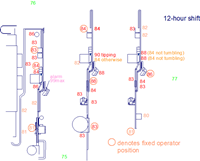
- Noise measurement results. Factories and fixed plant, use a factory plan drawing with colour coded measured noise levels and marked Noise Hazard Zones. For mobile plant, use a table - usually from an electronic database or spreadsheet that could also include HAVS data.
- Daily personal noise exposure calculations
- PPE: both theoretical and real-world protection calculations with details of the factors affecting performance
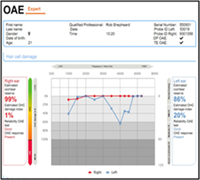
- Audiometry: the drawbacks of standard Pure Tone Audiometry (PTA) and why you should invest in Otoacoustic Emission (OAE) testing as a risk management tool asap
- Noise control best practice: why typical assumptions are not true; the only effective NCA procedure; the "Green Peace Dividend"; examples and resources
- Buy Quiet procurement policy summary
- Risk reduction RoI evaluation
- Brief summary of regulatory requirements
- Glossary
Final words and suggestions
The prevalent poor report quality is creating increasingly serious fiscal and ethical consequences. Much current report content is founded on false assumptions and does not include information and advice based on what now constitute current best practices.

The goal is "Nil NIHL". The good news is that if the Action Plans in reports are based on current best practices, then NIHL can be reduced by 75% - 90% largely within current budgets. You just have to know or be informed about what constitutes best practice. That’s the INVC objective, to have that knowledge and to pass it on...
How you assess and minimise noise risk is also rising up the insurance industry agenda due to the massive changes in the cost of claims. Effective reporting and actions are now very much on their minds.
It’s time to send back poor quality placebo reports. Perhaps acquire a copy of our soon-to-be-released template for ideas or just as a useful checklist re best practices. It’s time to settle on a high-quality report template for all future assessments to reduce NIHL and financial risks. It’s time to change...
Any comments or feedback would be very welcome.
Contact me if you'd like to discuss a particular problem or project where reporting is an issue.
