Links to all of the free downloadable guides, course details and other documents available on the INVC website:
Guides
Tips to Fix your Fan Noise Problem
Top 10 noise Control Techniques
Course Details
IOSH Noise at Work Risk Assessment & Management Course Details
IOSH Hand-Arm Vibration Risk Assessment & Management Course Details
Other Documents
Open Source Template HAVS Tool Register
HAV Risk Assessment and Management - Best Practice Guide


Hand-Arm Vibration (HAV) from prolonged tool use can lead to serious health issues like HAV Syndrome (HAVS), damaging blood vessels, nerves, bones and muscles. Even less obvious tools, such as bench saws, polishing wheels and engravers can pose a risk.
To help you manage these risks, our guide covers the essentials of HAV and outlines an effective HAV risk management programme to ensure you're in compliance with the Control of Vibration at Work Regulations 2005.
Download your free copy of the guide here >> Hand-Arm Vibration Guide
Accurate and effective frequency analysis - source ID and rapid complaint resolution


We have tested many apps. This is a detailed guide to using a very effective free Keuwl Android app for narrow band tonal noise analysis and identification (FFT noise analysis - download for free). Note: it is not available in the Playstore, you have to download using the above link.
Why use old fashioned 1/3 octaves that are not good at identifying tones and that throw away so much useful identification and diagnostic information when a smartphone FFT app can provide an accurate evaluation?
There can be no valid excuse to rely on subjective impressions or third octaves when tonal noise may be involved.
This is a simple process that dramatically improves noise complaint resolution, source identification and, with our help, BPM/BAT evaluation.
Once you've analysed, what next?
The results of your instant field narrow band analyses may be sufficient. You can determine if there is/isn't a tone or identify whether the tone is from a particular item of plant.
If you need help with tonal noise source ID or the mitigation options, then you can contact us to make use of our free remote analysis service.
Download your free copy of the guide here >> How to use a free Android narrow band frequency analysis app
Other narrow band apps - what to look out for?
Any useful FFT/spectrum analysis/narrow band analysis app should at least include the following:
- Resolution: ability to change the frequency resolution. This will often be described as the "FFT size" as x number of points. We would suggest you need to be able to select at least 4000 points (around 1Hz resolution for a 0Hz - 1kHz display.
- Max frequency: be able to reduce the frequency range for the analysis down to 0Hz - 1kHz as this is the range required for most environmental noise issues.
- Linear X axis: able to select linear rather than logarithmic as this allows you to see harmonics of a tone as a series of equally spaced peaks.
- Y axis: select dB
- Linear weighting: select this, not "A" weighted (if "A" is available)
- Cursor: to select and read the frequency of peaks. Ideally with a "snap to peak" function.
- Store setup: so you don't have to reenter the above to use the app.
- Export noise signature: ideally export as csv file so you can pull it into a standard Excel spreadsheet you've created to display spectrum graphs and overlay signatures. Better than the screenshot option.
Apple Apps
Whilst we haven't carried out testing on iOS apps, the following seem to meet the above requirements. We cannot vouch for their performance however...
Practical, non-academic noise and HAV training courses

As a major provider of HAV and Noise training courses in the UK, this document provides an overview of the standard courses offered by INVC, from toolbox talks and management briefings to IOSH accredited competency courses.
The workshop is non-academic and run by engineers with many years of practical experience.
If you have a requirement for training that is not included in our brochure, we also offer bespoke courses which can be developed to meet your needs - Get in touch.
Download your free copy of the brochure here >>
IOSH Training Courses Brochure
WBV Risk Assessment and Management - Best Practice Guide


Whole-Body Vibration (WBV) from prolonged exposure to vibrating equipment and vehicles can lead to serious health issues including back, neck and shoulder pain, potentially causing to headaches, digestive issues, circulation problems and impaired balance. Longer-term effects include chronic back disorders and nerve damage.
To help you manage these risks, our guide covers the essentials of WBV and outlines an effective WBV risk management programme to ensure you're in compliance with the Control of Vibration at Work Regulations 2005.
Download your free copy of the guide here >> Whole-Body Vibration (WBV) Guide
How to avoid dramatic increases in hearing loss claim settlements


A recent £713,716 Noise Induced Hearing Loss (NIHL) settlement presages the revised legal and medical landscapes surrounding hearing damage claims.
This case is the canary in the Noise Induced Hearing Loss (NIHL) costs mine, a canary that will soon be visiting any organisation that hasn't implemented the newly revised risk reduction best practices. A combination of an HSE inspection noise focus, new research on the underestimated NIHL damage to health plus legal framework changes is a perfect storm that will dramatically increasing the costs of not taking urgent action to cut NIHL.
The issues
- HSE noise inspection focus: 300% increase in enforcement actions, false assumptions re PPE
- New medical research: NIHL increases dementia risk by 500% (the largest modifiable risk factor)
- Quality of life: higher unemployment, 200% increased risk of accidents, early retirement etc...
- Revised legal framework: no lower limit on noise exposure, increased impact on health as above
How to mitigate - the newly revised best practices guide

As current typical hearing damage risk programmes have not worked well enough, urgent actions are necessary to reduce the risks and thereby the potential dramatic rise in future costs, including insurance premiums. The objective is Nil NIHL.
Fortunately, the following are the 5 areas where implementing the recent updates to best practices can reduce NIHL risk by up to c 90% with little or no effect on current expenditure.
- PPE performance: the attenuation is much less than you think. You need to understand why to improve protection
- Assessment and report quality: develop/acquire a high quality template for use in-house or by consultants
- Noise Control Audit (NCA): invest in a cost/benefit analysis of your noise control options
- Health surveillance: push for providers to switch from placebo audiometry to otoacoustic emission testing
- Return On Investment (ROI): calculate how effectively your resources are being spent and how it can be improved
Our 1 day online Noise Competency Update Workshop provides a quick, simple way to find out how to implement these revised best practices and to discuss your options with an expert.

PPE performance: 5dB - 10dB protection is much more likely than 20dB - 30dB
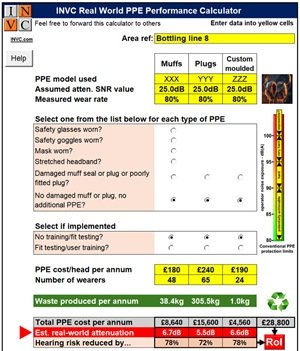
This calculator is based on research into the factors that affect the attenuation provided by PPE as used in the real-world. You really need to know what protection employees are likely to be achieving from their PPE, be it earmuffs or earplugs.
It will be only a small fraction of the assumed protection provided by the supplier.
Enter a few data elements into the calculator and it provides you with:
- an estimate of the worst-case real-world attenuation for the users
- the estimated total PPE expenditure cost per annum
- the estimated waste produced per annum
- evaluation of the effects of changing PPE performance factors
- links to PPE performance related resources
Combining this information allows you to calculate the Return on Investment (RoI) for your PPE use. It also allows you to explore "What if" calculations to improve PPE performance. Contact us to evaluate if there are simple options to cut risk dramatically using modern low-cost engineering methods (a 3dB cut halves the risk even if PPE is still required).
Note: you will need an up-to-date version of Excel to use the calculator.
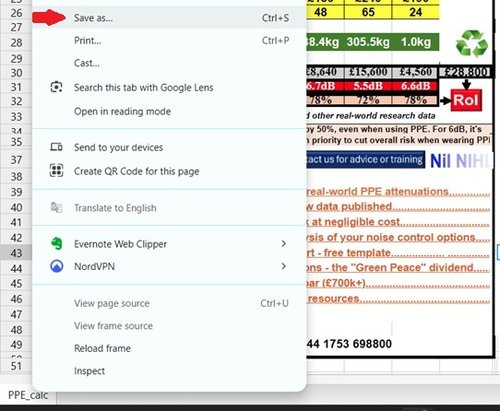
Browser displaying instead of downloading: Chrome
If using a browser that automatically opens the spreadsheet in the browser in compatibility mode, follow these instructions (Chrome).
- Right click the "PPE_calc" button at the bottom right of the displayed file in the browser
- Select "Save as..."
- Select your save location
Browser displaying instead of downloading: Microsoft Edge

Just click the blue "Download file" button

Our HAVBase HAVS field vibration database is used by many organisations to comply with the HSE guidance that recommends the use of vibration data from "reliable sources". Vibration measurements should only be carried out when that data is not available so that the resources saved can be used for risk reduction.
- by organisations who need a HAVS risk assessment. They simply send us their tool register for a virtual assessment as per the HSE guidance. This is fast and a fraction of the cost of conventional measurements
- by organisations who provide HAVS risk assessments as a service to their clients.
One of the latter organisation, Hygiene Partners, published a BOHS article that describes in detail how they use HAVBase to generate virtual risk assessments as part of their HAVS risk assessment process as a fast and cost-effective service for their clients.
