
Posted on: Jan. 26, 2026
Q1: why are so many noise reports so poor? A1: lack of tonal evaluation. Time to change...
Expressing 40 years of frustration since founding INVC... Peter Wilson
I was due to give a presentation at the 2019 CIEH INVC conference: "Why are most noise consultant reports inadequate". The title was changed at the last minute to "Noise consultant reports: current best practice approaches" because “Some of our colleagues in the industry mention to us that ‘most noise consultants’ is quite a generalisation and perhaps not the sort of message we should be saying, quite so strongly."
I remarked on this to a roomful of EHOs, saying I felt that around 80% of reports we saw were inadequate. The chair (IOA president at the time) pulled me up “You can’t say that...” I asked the audience. A couple said they strongly disagreed with my statement – as it was 90% or more...
2023 EA report quality survey: 95% of consultant noise reports were inadequate: 60% extremely poor, 30% very poor, 5% poor. EHO accuracy!

The serious consequences
- organisations waste a fortune on poor quality (often unnecessarily complex) noise reports
- companies waste a fortune on noise control measures based on guesswork (no diagnosis) that are not best practice
- complainants suffer unnecessarily for extended periods (see above). Problems that should be sorted within weeks often drag on for months or years...
- regulator resources (EAs and EHOs) are wasted due to the above
And the 1st major elephant in the noise industry room is...?
Report quality is a behemoth of an elephant in the room of environmental noise. It feeds into planning (inadequate and ineffective noise targets, ASHP standards, reports based on commercial interests etc), into complaint source identification, mitigation and, ultimately, into the associated serious and widespread health effects. UK Chief Medical Officer: noise is 2nd only to air pollution in damaging public health. Exposure is linked with up to 27% increased risk of dementia etc. etc.
Let’s take a look at just one serious part of the elephant as an example - with case studies that demonstrate just how misleading noise reports can be.
Why is frequency analysis, a powerful and effective tool, so generally ignored?
There is an acoustician plot. Noise must remain a complex dark art requiring a brain the size of a planet to understand. It must not be simplified or democratised and must remain a priesthood purview.

Can consultants be regarded as competent if they don’t use narrow band frequency analysis to evaluate complaints about tones or as a powerful diagnostic tool to aid mitigation? I think not. Most don’t, despite it being available as easy to use free smartphone apps. Seriously? Is it sacrilege to suggest that anyone can assess tonality without spending a fortune on sophisticated kit?
The same lack of tonal analysis is also prevalent when consultants are considering noise control to reduce hearing damage risk.
Cue outcry from acousticians as below.
I've been quite successfully pushing the use of smartphone apps for narrow band analysis instead of relying on subjective judgement that is notoriously poor. The IOA did not like it at all as per their following public critique extracts:
The Appropriateness of Smartphone Apps in National Guidance: IOA comments

(1) ...Smartphone apps are now included in XXX as a means to subjectively assess tonal noise and are listed as a helpful aid... This would still require a relatively high level of expertise and knowledge to be used correctly. Understanding acoustics is required, especially in understanding the method and equipment limitations... Could it be misused?
(2) ...We propose the removal of all smartphone references from the XXX guidance as they do not meet Class 1 instrumentation requirements as stated in BS EN 61672. In conclusion, we believe Smartphones are not suitable for measuring or assessing environmental noise, especially as only competent persons should be completing noise impact and compliance assessments.
INVC has been using smartphone apps for years. We’ve helped people and organisations use them worldwide to assess noise and to send us video clips for analysis. We run regular webinars to train EHOs in their use. We have proved it works well. We have proved it is highly effective. The noise industry insistence on only using costly specialist instrumentation is both a red herring and a straw man argument. Obviously there is a need for specialist, calibrated instrumentation, but not for everything. See why their comments re calibration and accuracy are not relevant for most tonal noise applications.
Example: data centre planning – listen to that hum I’m actively ignoring
Noise impact assessment report for a proposed 2nd Data Centre to support the planning application. I reviewed and proved that it was not an accurate representation of the likely noise impact from the proposed new facility because:
Tonality
Consultancy: “There’s no evidence that there will be tonal noise.” This is despite tonal noise being the cause of complaints from the existing data centre and the fact that low frequency tonal noise is a very common cause of complaints from the plant used. The consultant specifically did not measure or model anything that could reveal tonality and that could result in a 6dB BS4142 penalty being applied.
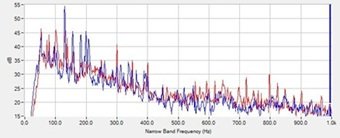
I asked a resident for smartphone video clips at 150m from the existing facility, the narrow band analysis of which proves it is highly tonal. Apparently, if you listen to this audio clip, there are no tones!
What conclusions can you draw? The report appears to have been written specifically to get through planning by ignoring tonality, whatever the downstream consequences to the local population and the impact on EHO resources to deal with future complaints.
Mitigation
Consultant: “The planned mitigation will reduce the noise from the new facility to the lowest level possible.” Untrue. Only a very limited set of noise control measures were considered, proven engineering mitigation measures that often represent Best Practicable Means (BPM) were ignored. These would not only be particularly effective to reduce tonal noise, but could also improve plant efficiency and dramatically cut mitigation costs, a substantial benefit to the client developer. This is an example of the fact that typical consultant knowledge of modern diagnostic and noise mitigation methods is truly abysmal.
Example: Battery Energy Storage System (BESS) – nothing to hear here
Another noise report for me to review. Here we go again:
- Supplier noise data was converted from 1/3 octaves (whilst not reliable, it might have indicated tonality) to octaves. Would it be cynical to ask why they deliberately discarded useful data on potential tones?
- The gold standard BS4142 requires up to a 6dB(A) penalty if there are tones. The report did not apply that penalty, despite the fact that this type of plant is almost invariably tonal.
As a minimum, best practice should be to put the onus on the developer. The maximum 6dB penalty should be applied automatically unless they can prove, using narrow band frequency analysis data, not 1/3 octaves, that it is not. When we generate planning noise reports, we try to acquire short audio recordings of similar plant in operation anywhere in the world (smartphone video clips are fine) so we can not only confirm any tonal content, but diagnose the cause to aid mitigation.
Don’t take noise reports at face value because – terminological inexactitudes...
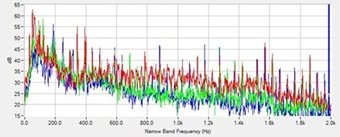
Planning noise impact report for a housing development. The developer has a building fitted with numerous condenser units abutting the site. Noise consultant:
- measured on the other side of the site to the noise sources, not at the nearest noise sensitive location
- claims the units are “barely audible” even close-up and states there is subjectively, "no detectable tonal sound"
- calculated noise from the units using manufacturers’ data as this was “more accurate than measurement”!
- no measured indication of tonal sound at night (conveniently, dB(A) can't)
- “…there is no need to consider additional measures to attenuate the sound of the condensers. The proposed development meets the sound impact standards for planning approval.”
Based on what the EHO had learned on one of our webinars, he queried the report and forwarded a smartphone video clip for analysis. Apparently, this audio file contains no tones, despite the fact that analysis shows the noise to be all tones... The consultant has had the gall to aggressively attempt to defend his indefensible and deliberately misleading position.
The prosecution rests.
Final words and suggestions

A large proportion of noise complaints are caused by tonal noise. And yet most consultants do not use narrow band frequency analysis to evaluate tones, despite it being best practice. At best, they may try 1/3 octaves, but this is an unreliable technique. Why use 1960s technology when even a free smartphone app provides much superior results?
Why throw away all that juicy information you could use to diagnose the precise causes of noise for mitigation by limiting yourself to dB(A) and octaves (and maybe, if you’re feeling technical, 1/3 octaves)? More of this in a future post.
During a webinar, an EHO who had just completed the IOA diploma course said that tonal noise analysis was never mentioned. That would be a good start. We have proved across a multitude of worldwide projects that smartphone recordings and apps are very effective, useful and valid tools, far superior to subjective impressions or 1/3 octaves. We’ve also proved that it is easy to show people how to use them.
Is it possible to be considered to be a competent noise consultant if you don’t use tonal analysis to identify tonal noise? I'd say no as there is no excuse.
I recommend that all planning requirements should at least include the full BS4142 6dB tonal noise penalty by default, unless the developer and noise consultant can prove there are no significant tones by using narrow band frequency analyses.
After >40 years in the noise industry, after running countless workshops and presenting at conferences across the world, I’m depressingly disappointed in the current state of that industry worldwide. Whilst there are many good consultants out there, based on what we see, they are a minority. I’d say, in general, a “D: could do much better”.
More exposees to follow in future posts after I've had a lie down in a darkened room... Contact me if you'd like to discuss a particular problem or project where reporting or tonality is an issue.
